
Big Spring Previous Residents Sources
Different sources cover different slices of a Big Spring address. Howard CAD is the most direct public parcel route for the recent tax years it displays. The Howard County Clerk holds recorded instruments, but the online date cutoff was not located in official sources. Dated directories and newspapers can place a household at an address, while census schedules provide a household snapshot at the census date. City permits may add a building or project clue. Each source should be treated as evidence of its own date and purpose.
| Source | Years it covers | Where held | What it can establish |
|---|---|---|---|
| Howard CAD public search | 2017-2026 visible tax-year choices | Howard County Appraisal District | Recent tax-account details, property IDs, legal description, owner display, and situs address |
| Howard County Clerk index | Online cutoff not located | Tyler portal, clerk counter, mail, phone, or fax | Recorded instruments and parties; the index is not the document image |
| Big Spring directories | 1928, 1930, 1931, 1934-35, 1962, 1978, 1985, 1990, 1991, 1994 cataloged | FamilySearch catalog and library or society holdings | Dated name, address, business, or civic references where present |
| Enterprise and Herald | Enterprise 1908-1911; Herald 1921-September 2018 digitized | Southwest Collection and Howard County Library | Notices, obituaries, address clues, and local context |
| Federal census | Subject to the 72-year access rule | Census repositories and library research | Household evidence at a census date, not current residence |
| City permits | Public archive start not located | SmartGov or City Public Information Act request | Project, inspection, and construction-timeline leads when released |
Start with CAD when the recent parcel is clear. Start with a directory or newspaper when the question is a former household. Use the clerk route when ownership or an instrument matters. A date gap is a normal research result, especially because the located directory editions are discontinuous and the recorder portal’s online coverage has not been verified.
Big Spring Deed Chain Backward
A chain of title is the sequence of recorded ownership-related instruments connected through a property’s legal description and parties. Begin with the Howard County Appraisal District public property search, then move to the Howard County Clerk’s Tyler records portal. CAD helps anchor the current property identifiers. The clerk index can then point to deeds, releases, assignments, liens, easements, plats, probate transfers, and foreclosure-related records. Do not call a CAD record a deed, and do not call every recorded instrument a transfer.
- Search the current Big Spring address in CAD and record the displayed owner, property ID, geographic ID, tax year, and full legal description.
- Search the current owner or entity as a grantee in the clerk index, using spelling variations and the legal description where available.
- Read the resulting deed image or request a certified copy from the clerk. Capture the grantor, grantee, recording date, instrument number, and referenced prior record.
- Use the seller from that instrument as the next grantee search, then repeat the process backward while the legal description continues to match.
- When online results stop, ask the clerk for the available counter, mail, phone, or fax procedure rather than assuming the chain ends.
- Grantor and grantee
- The grantor is the party conveying an interest in an instrument; the grantee is the party receiving it.
- Chain of title
- A documented sequence of instruments traced backward through the parties and the same legal land description.
- Legal description
- The lot, block, addition, abstract, survey, tract, or other land wording that ties old instruments to a property more reliably than a street form.
- Index-only lead
- A catalog-style entry that helps locate a record but does not replace its image or certified copy.
Howard County Clerk research encountered an acceptance screen and human-verification gate, so live index fields, image availability, fees, and online coverage dates were not observed. For a document request, give the office the parties, approximate date, instrument type, legal description or property ID, and any known clerk-file number or volume and page. The clerk’s listed office is at 300 S Main Street, Room 104, Big Spring, with telephone 432-264-2213.
Big Spring Recorded Instrument Gaps
Past residents and past owners are related but different questions. A deed of trust records security for a debt, not beneficial ownership. A release may clear a lien without showing a sale. A substitute-trustee notice announces a proposed sale process and must be followed to a later deed or clerk entry before it is treated as a completed transfer. The clerk portal itself warns that its index is a finding aid and advises users to try spelling variants. Preserve the type of document with every party name.
Certified copies come from the county clerk. The office’s posted recording fees are $25 for the first page, $4 for each additional page, and $0.25 for each name over five, but confirm a current payment amount before sending money. The clerk’s public page says it does not conduct real-property searches, which is why a narrow request with a legal description or an existing instrument reference is more practical than asking the office to identify a property from scratch.
Note: A clean backward trail records uncertainty, including an index-only entry, a missing image, or a gap between available sources.
Big Spring Permit History Clues
City permit material can help date a change at an address, such as a remodel, carport, fence, gas line, manufactured-home, or solar project. The Big Spring SmartGov service offers public navigation for applications, inspection results, documents, and contact routes. Its public Reports area stated that no reports were available during research. That is a service limitation, not evidence that a property has no permit history.
For a house-history question, request the address-specific permit or inspection record, use an approximate date range, and name the project class. A request through the city’s Texas Public Information Act channel can also ask for electronic delivery or a fee estimate. Read applicant, contractor, owner, inspector, and completion fields as separate roles. A permit may support a chronology, but it cannot establish who occupied the address.
Note: Keep each permit role separate, because the named applicant, contractor, or inspector may not be a past resident.
Big Spring Map and Annexation Dates
Historic geography can explain an apparent move that never happened. A 1940 Census historical volume notes that parts of Howard County precinct 1 were annexed to Big Spring in 1927, 1929, and 1930. An older directory, census, tax roll, or map may therefore use a county description for a tract inside today’s city. Compare the geography as of the record date rather than forcing an older source into modern city boundaries.
The Texas State Library and Archives Commission catalog lists Howard County map holdings including 1925, 1940, 1951, 1961, 1972, 1983, 1989, and 1991 examples. A catalog record proves a map exists, not that a particular modern address has been matched. Inspect the scale, sheet, roads, rail lines, townships, and notes before building a crosswalk. No specific Big Spring Sanborn sheet or date was located in the research, so no Sanborn coverage is asserted here.
Note: A historic map supplies geography at its own date, not a complete answer about a current parcel or household.
Big Spring Previous Household Trail
Owners are only one layer of an address history. Howard County Library is the local route for newspapers, obituary research, genealogy leads, and references to the Southwest Collection. Its local-history material reports Big Spring Herald microfilm from 1901, including the period when the newspaper was called The Enterprise. The obituary index is not online, but the library can make an obituary copy when the researcher supplies an exact death date. That makes a dated newspaper notice a useful endpoint or confirmation for a former household.
The Howard County Library location and hours page identifies the Big Spring library and its reference contact information.
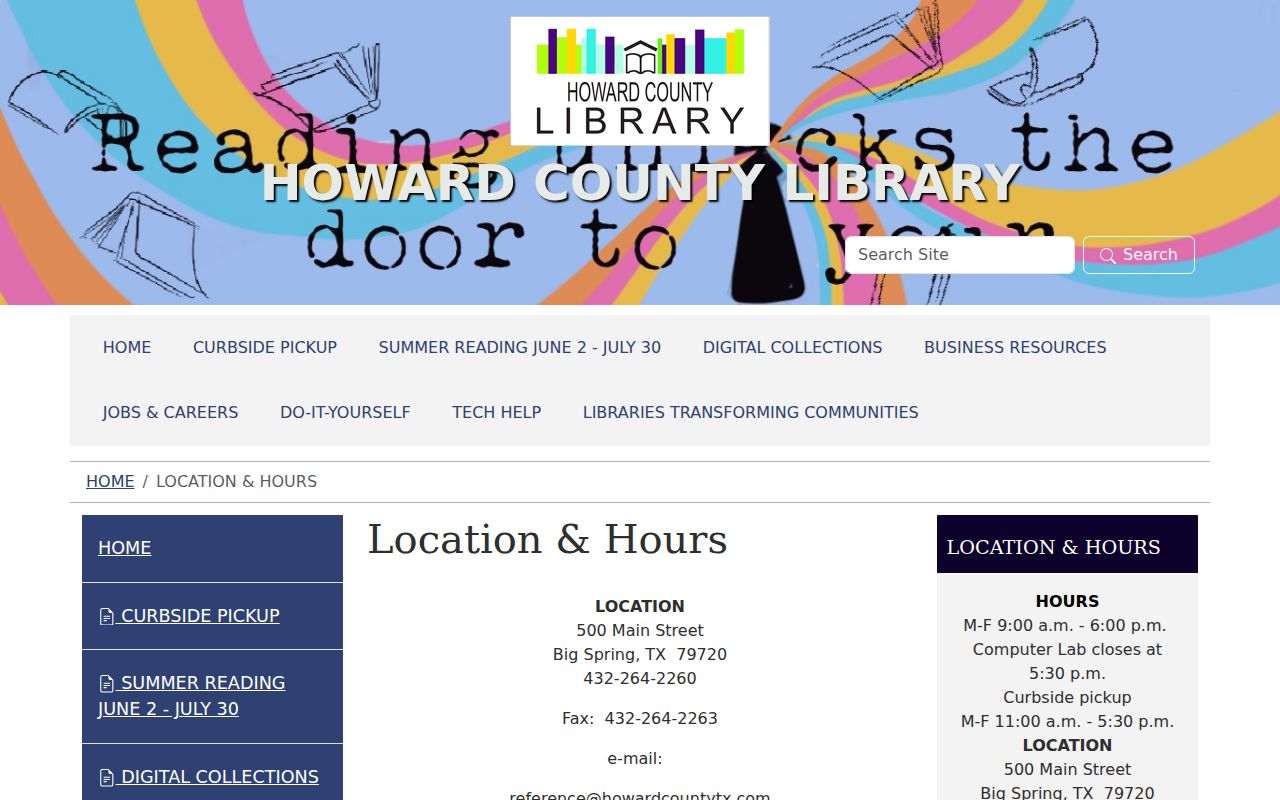
The library reports Monday through Friday hours of 9 to 6 and a Saturday closure, though current access, copying rules, and staff availability should be confirmed before a visit. Its Southwest Collection links help extend the address trail to the digitized Big Spring Enterprise and Herald runs, but a search result still requires inspection of the original page.
Note: A newspaper search result is a lead; inspect the original issue before using a notice as address evidence.
Big Spring Directory and Census Pairs
Pair a dated directory with the nearest accessible census rather than treating either as a continuous list. FamilySearch’s catalog identifies Big Spring items for 1928, 1930, 1931, 1934-35, 1962, 1978, 1985, 1990, 1991, and 1994. Some content is indicated as online, but access can vary by account or location. The exact page is what establishes a household fact. A catalog entry says only that a holding exists.
- Locate the address in an available directory edition and capture the year, publisher, reel or item, page, and exact street spelling.
- Check whether the edition has an address-first section, then compare the listed name with the alphabetical section when both exist.
- Use the next available directory edition to mark a change or continuity, while allowing for skipped publication years and spelling shifts.
- Pair that dated entry with an accessible census schedule and preserve its enumeration date and geographic label.
- Use a newspaper, vital, probate, or cemetery source to test a move, death, marriage, or estate event without converting it into a current address claim.
A criss-cross directory is an address-first ordering that can name the listed occupant or subscriber. A dedicated Big Spring reverse-directory year run was not found in the official catalog. The Big Spring city directory page identifies the collections themselves; for an address trail, use them as dated snapshots and retain the citation details.
Big Spring Previous Resident Endpoints
Obituaries, probate files, cemetery lists, and newspapers can help close a trail after a resident left an address or died. The city-run Mount Olive Cemetery has alphabetical burial PDFs that record a name with a lot and block code. The city reports more than 12,000 graves, an oldest known death date of 1883, and an 1884 establishment after the original cemetery was ordered moved. It also warns that family markers and West Texas weather can affect the accuracy of the records.
The Mount Olive burial-list collection is an official route to its alphabetized PDF sets.
A burial entry and lot code can corroborate a family-history or obituary lead. It does not establish ownership, an exact grave location, or a current address. Confirm an important cemetery record with staff at 432-264-2323 or with the marker and original documents.
Big Spring Address History Limits
Research on previous residents should remain a house-history, family-history, estate, or civic-record exercise. Public records can be incomplete, old, indexed under a variant, or intentionally suppressed. Texas voter rules protect certain addresses and identifying fields, and the Texas Address Confidentiality Program may use a substitute mailing address for qualifying participants. Never attempt to infer a protected physical location from a substitute address or from combined records.
Lawful use. Use Big Spring address history for lawful personal research, and do not use a past-resident trail to stalk, harass, threaten, or harm any person.
The Texas Public Information Act is a request route for releasable government records, not a way around confidential fields or access restrictions. Mark whether evidence is a direct image, an index entry, a catalog description, or an inference. That distinction keeps an address history honest when sources disagree or a record is unavailable.